Hair transplant in Riga with the FUE method — follicles transplanted one by one, without stitches or a linear scar
On this page we explain, step by step, how an FUE hair transplant (follicular unit extraction) is carried out at the Rubenhair clinic in Riga, Latvia: from preparing the donor area to implanting each follicle. First, try our free simulator and see what your result could look like.
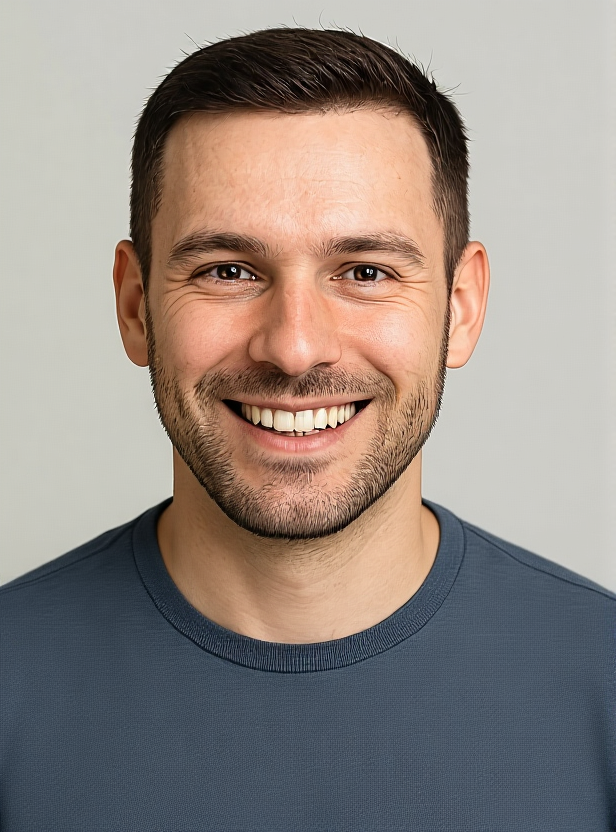
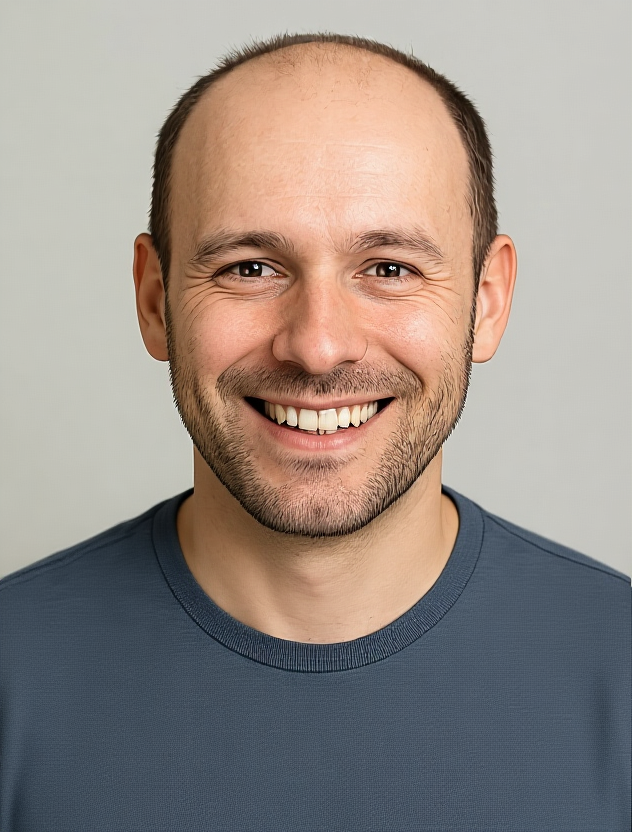
Hair transplant in Latvia for international patients
Rubenhair is a hair transplant clinic in Riga, Latvia, serving both local and international patients. We use the FUE (Follicular Unit Extraction) method: the surgeon removes individual follicular units from the permanent donor area at the back of the scalp and places them where the hair is thinning. Because donor hair is genetically resistant to balding, the transplanted hair keeps growing for the long term.
The whole procedure is done in a single day under local anaesthesia and leaves no linear scar or stitches. Our surgeon is an ISHRS member, the clinic has operated since 2013 and completed more than 2000 procedures. For patients travelling from abroad, Riga is a short, affordable flight from most European capitals, and pricing is considerably lower than in Western Europe — an FUE hair transplant costs from €1,900, with the final price depending on the number of grafts.
Every treatment starts with a free online consultation, where the surgeon assesses your donor area and Norwood level and gives you an exact quote. See indicative hair transplant prices or call +371 267 777 76. The clinic is located at Republikas laukums 3, Riga, LV-1010, Latvia.
Graft Calculator
Find out how many grafts you need
Select your hair loss level
Select Norwood scale level
This calculator provides only an approximate estimate.
Free Online Consultation
Contact us today
Hair Transplant Procedure | Rubenhair Hair Transplant Clinic in Latvia
FUE hair transplant in Latvia — follicular unit extraction
FUE (Follicular Unit Extraction) is a modern hair transplant method in which hair follicles are harvested one at a time — in small natural groups of one to four hairs. Unlike the older strip (FUT) method, FUE requires no skin incision or stitches: the surgeon removes each follicle individually with a fine punch instrument of roughly 0.7–0.9 mm. This leaves only tiny dots in the donor area that become almost invisible over time, rather than a linear scar.

How FUE is performed step by step
The entire procedure takes place in a single day under local anaesthesia. Below are the main stages, so you know exactly what will happen at each point of the operation.
1. Preparation and design
The doctor draws the new hairline, agrees it with you and determines the number of grafts needed. The donor area at the back of the head is trimmed short, local anaesthesia is administered, and the area being treated becomes completely numb.
2. Extraction one follicle at a time
Using a micro-punch instrument, the doctor removes hair follicles from the donor area one by one. Each graft is immediately checked under magnification and kept in a holding solution at a controlled temperature to preserve its viability.
3. Channels and implantation
In the recipient area the doctor creates tiny channels, precisely setting the angle, direction and depth of each hair — this is exactly how a natural look is achieved. The follicles are then placed into the channels one by one.
No stitches, no linear scar — and high graft survival
The advantage of FUE is not only aesthetic. When extraction is done correctly and the team works quickly, most transplanted follicles take root and usually grow long-term. Below are three aspects that determine the FUE result.
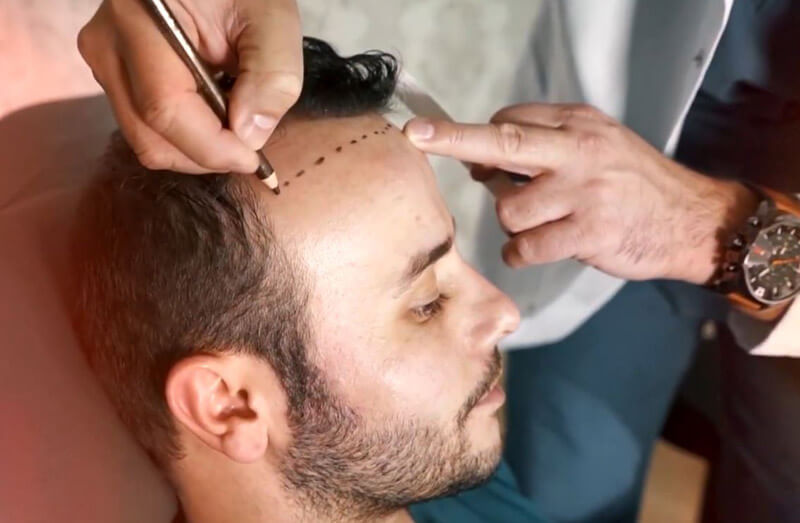
No stitches or linear scar
Because the follicles are removed with a punch instrument, no linear scar remains in the donor area — only tiny dots that heal within a few days and are not noticeable even with a short haircut. No stitches are needed, so recovery is quicker and more comfortable.
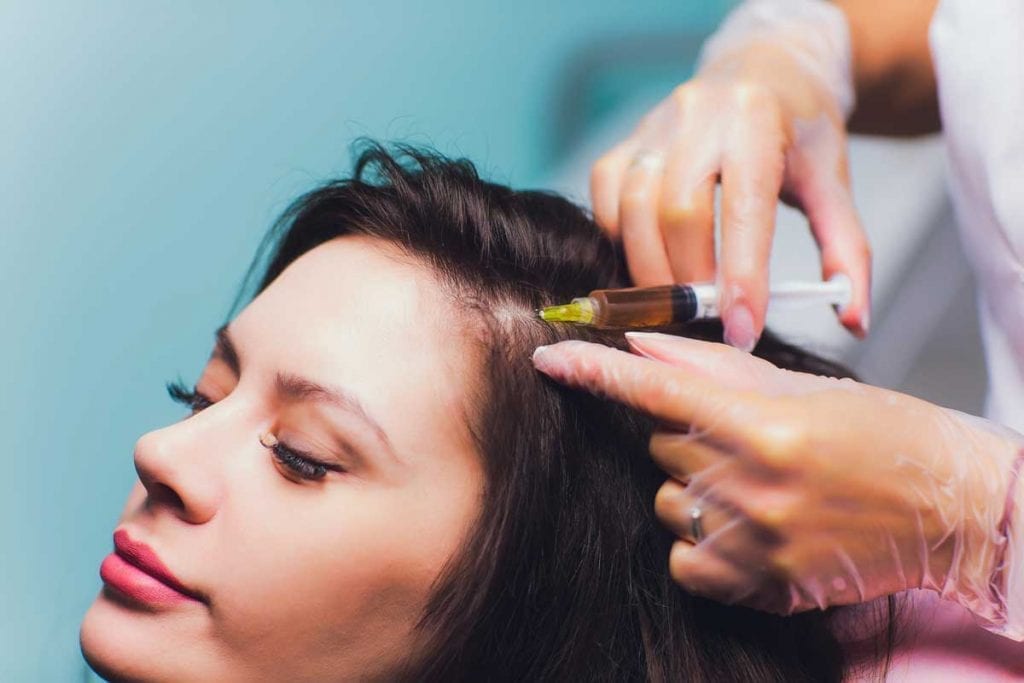
High graft survival
A follicle's viability depends on how long it spends outside the skin and on careful handling. Our team works quickly and in coordination, keeps the grafts in a holding solution and implants them as soon as possible — this way most transplanted follicles take root successfully.

Who FUE is suitable for
FUE suits men with androgenetic alopecia, a receding hairline or thinning at the back of the head, as well as women with thinning in specific areas. The main prerequisite is a sufficiently dense donor area at the back of the head. Suitability is assessed precisely at a free online consultation.
In addition to surgery, we also offer hair restoration with plasma injections (PRP) — a natural way to strengthen hair follicles. See the full range of services at the Rubenhair clinic.
Real patients, real results
Genuine before-and-after results from our hair transplant procedures — documented at our clinic and shown exactly as they healed.
 Before
After
1 year
 Before
After
3 months
 Before
After
6 months
 Before
After
1 year
 Before
After
1 year
 Before
After
1 year
 Before
After
1 year
 Before
After
1 year
 Before
After
1 year
 Before
After
1 year

The operation went smoothly... 14 months have passed and the hair is growing great, indistinguishable from the surrounding hair, no scars, hair loss or any noticeable side effects.
Māra V.
Excellent and friendly service. Very responsive customer support. The procedure itself was quick and painless, they explain every step...
Sim-S
I am satisfied with the results. They prescribed all the necessary medications. I can recommend!
Titi
FAQ about the FUE method
Answers to the questions most often asked before an FUE procedure.
Is the FUE procedure painful?
The extraction and implantation themselves are done under local anaesthesia, so you feel no pain during the operation. The only discomfort may be when the anaesthetic is administered. For a few days after the procedure there may be mild tenderness, which is easily controlled with ordinary painkillers.
Why doesn't FUE leave visible scars?
Follicles are removed one at a time with a small round instrument, without a skin incision or stitches. As a result, the donor area is left with only many tiny dots that heal quickly and are not noticeable — unlike the single linear scar left by the older FUT (strip) method.
How many follicles (grafts) are harvested in one session?
It depends on the density of the donor area and the size of the area to be treated. The doctor determines the exact number at the consultation, taking into account your hairline and your degree of hair loss on the Norwood scale. You can get a rough estimate right now with the graft calculator.
Will the transplanted hair fall out?
In the first weeks the transplanted hairs usually fall out — this is completely normal and does not mean the follicle is damaged. The follicle stays in the skin and after a few months starts growing a new hair. Because the grafts are taken from the genetically resistant area at the back of the head, the new hair lasts long-term.
How much does a hair transplant cost in Riga?
The price depends on the number of grafts needed. An FUE hair transplant in Riga costs from €1,900. You will receive an exact price at a free online consultation, and a rough estimate right now with the graft calculator.
How long does an FUE hair transplant operation take?
Most FUE procedures are completed in a single day and take about 5–8 hours depending on the number of grafts, with short rest breaks. By the next day most patients can return to their daily routine, following the doctor's instructions.
How many grafts are needed for a hair transplant?
It depends on the degree of hair loss on the Norwood scale and the density of the donor area. A hairline correction often needs 1500–2500 grafts, while more extensive thinning may require 3000–4000 or more. The doctor determines the exact number at the consultation.
When will the final hair transplant results be visible?
The first density appears after 4–6 months, and the final result after 12–18 months, once all the new hair has grown in and thickened. Patience is important, as hair grows gradually.
What is the "ugly duckling" stage after a hair transplant?
This is what roughly months 1–3 are often called, when the transplanted hairs have already fallen out (shock loss) but the new ones have not yet grown. Your appearance at this stage may seem uneven, but it is a completely normal, temporary phase on the way to the final result.
When can I wash my hair, wear a hat and exercise after a hair transplant?
Gentle hair washing usually starts as early as day 2–3, following the doctor's instructions. A loose hat can be worn after a few days, avoiding friction against the grafts. Intensive exercise, sauna and swimming are best postponed for about 2–4 weeks.
Is a hair transplant suitable for women?
Yes. FUE is also suitable for women with a stable donor area — for example, for a thinning hairline or to restore density in specific areas. It is important to first establish the cause of the hair loss, so suitability is assessed at the consultation.
How soon can I return to work after a hair transplant?
Most people can return to office work after just 1–3 days. A longer break is advisable for physically demanding work. In the first days there are small scabs in the recipient area and possibly mild swelling, which pass quickly.
How is the donor area chosen and prepared for a hair transplant?
The donor area is chosen at the back and sides of the head, where the follicles are genetically resistant to hair loss. Before extraction it is trimmed short and local anaesthesia is administered; the doctor removes follicles evenly so the donor area does not look visibly thinned.
Hair loss and hair treatment
Hair loss often begins gradually, and surgery is not always necessary — at first, identifying the causes of hair loss and appropriate hair treatment can help. If hair loss has progressed, an FUE hair transplant restores hair naturally and durably.
Procedures are performed by a surgeon who is an ISHRS member
A hair transplant is a medical procedure, so it is important to entrust it to a qualified and experienced specialist.
Dr. Andrejs Milcevskis is a member of the ISHRS (International Society of Hair Restoration Surgery) and a hair transplant surgeon with more than 10 years of experience in hair restoration and more than 2000 procedures performed. He specialises in the manual FUE method, paying particular attention to a natural hairline, the correct graft angle and a durable, natural result.
Why this matters: ISHRS is an international professional organisation for hair restoration surgery. Membership means the specialist has committed to following internationally recognised ethical and quality standards and to regularly updating their knowledge of the latest methods in the field.
Contact Us!
Phone
+371 267 777 76Address
VITUM SIA
Reg. No.: 40103626380
Republikas laukums 3
Riga, LV-1010
Latvia
Working Hours
Monday - Friday: 09:00 - 18:00